Ascetic Computing
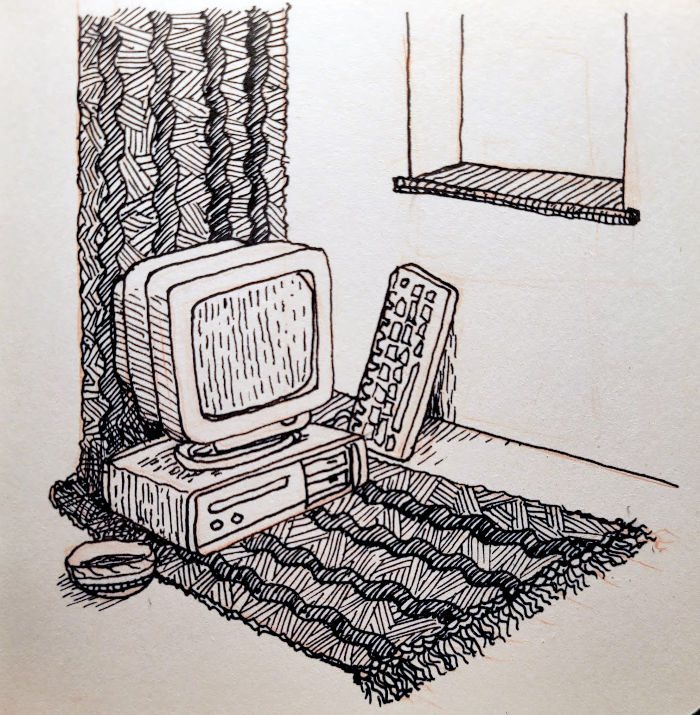
(Sketchbook drawing by the author, fountain pen.)
I recently came across a comment I’d written in a configuration file. It was above some commented-out lines. It said:
# I opted to do without this for ascetic reasons.
I often put a fair amount of effort into perfecting and cleaning up source and configuration files for aesthetic reasons, so this comment briefly threw me for a loop. Then I chuckled. How droll.
The more I thought about it, thought, I had to conclude that I’ve been doing a lot of things lately for "ascetic reasons".
As the asceticism article (wikipedia.org) begins:
"Asceticism is a lifestyle characterized by abstinence from worldly pleasures through self-discipline, self-imposed poverty, and simple living…"
I acknowledge we moderns often give asceticism a religious and spiritual flavor, but the term predates that use and originates with regular old down-to-earth self improvement. (More on that in the section Keeping Sharp below.)
Further, the brand of asceticism I’m thinking of is a "natural asceticism" which results from a pursuit of simplicity and focus, not an asceticism of suffering or denial for its own sake! Rather than picturing a starving monk in a hair shirt, imagine something more like Henry David Thoreau in Walden: "I went to the woods because I wished to live deliberately" a life not "frittered away by detail."
(Hey, look at me, I’m the Thoreau of computing! Seriously, though, the comparison is pretty apt because, like Thoreau, I haven’t strayed very far from civilization and still make regular use of it. For what it’s worth, I do laundry.)
What it means to me
I’ve come up with a list of principles that are the basis for my ascetic computing.
Before I give you the list, understand that I mostly live by these principles, but not always. Just search for "Faust" and "Faustian" on this page.
Here’s what "ascetic computing" means to me:
-
Doing without things that compromise my personal standards or morals.
-
Learning to live Fearlessly in the face of Missing Out.
-
Resisting the Endless Pursuit of Shiny Things.
What’s interesting is that the word computer does not appear even once. Someone 200 years ago probably would have understood my list, and could figure out, after a moment of pause, the modern idioms "Fear of Missing Out" and "Shiny Things".
All three of these principles are challenging, but I think the Shiny Things are my final boss. I’m one of those people who follows the links on Wikipedia and finds themselves with 30 tabs open an hour later. Or who buys supplies for hobbies with the full intention of doing that hobby for the rest of my life. And then…doesn’t.
(Aside: Shiny Things aren’t all bad. If nothing else, I used to learn a lot of new subjects! The problem I had with them is that when I was always chasing the new fashions in computing, I never gave myself a chance to dive deeply into the things I really cared about. But what if you don’t know what you really care about? To figure that out, I think you probably should look at the Shiny Things when you’re starting out. Then shift to a more "slow and steady" pace when you’ve started to figure yourself out. What is shiny now may become a well-worn old favorite a decade from now.)
Anyway, I’d like to point out that deprivation is not on the list. A certain amount of deprivation may occur as a result of following the three principles, but it’s not the goal.
The goal is to live a (computing) life of principle, purpose, and focus.
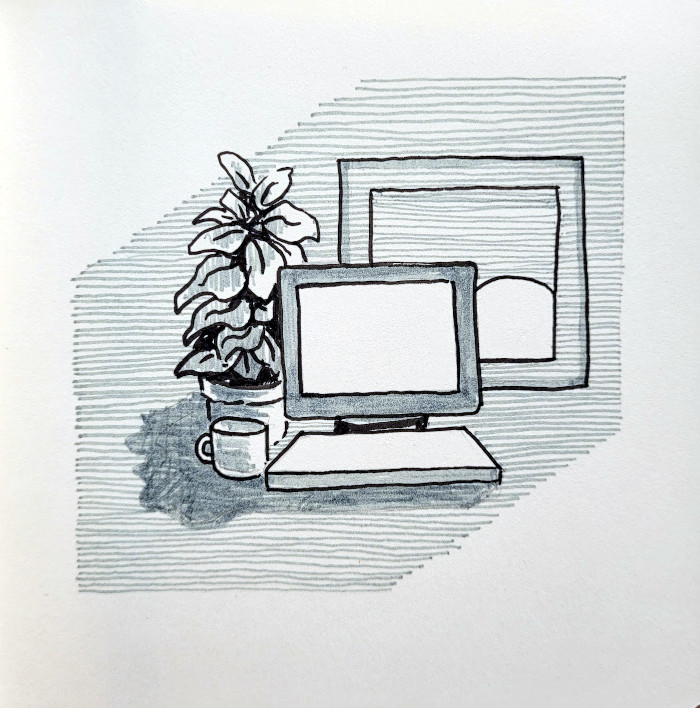
(Sketchbook drawing by the author with black and gray liner pens.)
I’m not kidding, I really do enjoy computing like this
I have no desire to wander into the desert with a laptop computer and some solar panels and starve myself until I go on a vision quest. But I do seek the sort of simplicity that would entail.
The goal is to be able to concentrate on the things that are important to me with as few distractions as possible. I wish for my natural state to be either A) learning, creating things, and writing or B) resting.
Another way to look at it: Rather than deprivation, I see this as enjoying what I have, which is a lot. See also In Favor of Enjoying Things on Purpose (raptitude.com) by David Cain.
Finally, to be explicitly clear before we go any further, because some people will insist on misreading this article: Nothing I do on computers is masochistic self-denial or performative mortification to impress anyone. Quite the opposite! I find my habits pleasurable and satisfying.
Nor has this been a sudden proclamation I just made one day. It’s simply a natural mode into which I’ve settled at this stage of my life.
In short, I wouldn’t do it this way if I didn’t like it.
Simplicity and things that just work
I have adored the following Flaubert quote ever since I was introduced to it in a book chapter titled "Be Boring" by Austin Kleon (austinkleon.com):
"Be regular and orderly in your life, so that you may be violent and original in your work."
I’m at the point in my life where I’d rather spend my creative energy on a project of my own creation than fighting my operating system and tools.
I’d rather do without a few conveniences if it means less complications and breakages and distractions.
No distractions
For me, this means not using operating systems and software that presume they are entitled to use my computer to interrupt me for anything. My time and attention is in very limited supply and very precious to me. Stealing my time is a crime!
Software that actively distracts me? You might as well tell me I should run a program that steals pieces of silverware from my kitchen when I have my back turned. Are you nuts? Who would do that?
My computing setup is relaxing. It’s a little bit like this website: quirky, but stable. No popups. No "toast" notifications. Just a machine calmly waiting for my input.
I’ll let you in on another fact, and brace yourself because this one may shock you: I prefer operating systems and software that do not automatically update themselves, even for security reasons. I update my operating system and software when I am ready. Call me a computer security heretic if you like and I will laugh and respond like the sicko I am, "Ha ha, yes!"
Current favorites for being productive on the computer:
-
OpenBSD for the OS because it is cohesive and Just Works.
-
Vim for the text editor (lots of good choices in the editor category).
-
Dillo for browsing the web for a specific piece of information and then get the heck off and go back to whatever I was working on.
-
Ruby for scripting handy personal utilities.
OpenBSD’s 6 month release schedule is perfect for me.
I’m pretty new to daily-driving Dillo as the main browser on one of my computers, and I’ll probably have more to say about it in the near future.
You likely disagree with some of those choices. Great! This list should be individualized and opinionated!
Less fragile
Imagine you are on a very long cross-country journey. You brought a bunch of nice equipment with you. Some of it was complicated and fragile and it broke. You had to discard those things along the way. Only the things that didn’t break or were easily repaired remain. Those pieces of equipment are your trusty companions.
The idiom to use something "in anger" means to use it "for real" as opposed to just playing around. The phrase is so colorful and it makes me picture someone in a cold sweat furiously typing on a computer (perhaps with a handful of onlookers). Something important hangs in the balance.
When those moments come, you suddenly stop caring what things look like and how fashionable they are. You just care if they work. In times like that, you remember which tools let you down and which ones don’t!
In my experience, the simpler something is, the less fragile it tends to be.
Things that last
I love learning new things. But at some point, it began to dawn on me that my learning often went into one of two categories:
-
Knowledge that was transient, sometimes even single-use.
-
Knowledge that lasted and would transfer.
Learning proprietary software has tended to go into the first category.
Learning BIOS/UEFI settings and hardware minutia has largely gone into the first category (and it stinks because sometimes you practically have to make a pact with demons for that information).
Learning the fundamentals of programming goes in the second category.
Learning Unix fundamentals, including programs that have been around since the 1970s goes in the second category.
Note my use of the word "fundamentals" in those last two items.
I’ll invoke the Lindy effect (wikipedia.org) which seems, in my experience, to hold true:
"Longevity implies a resistance to change, obsolescence, or competition, and greater odds of continued existence into the future."
The vi editor was released in 1976. 50 years ago! People still use it (yes an actual vi like nvi) every single day. It well may go on for another 50.
(As an aside about the staying power of 1970s technology, trust me, I find it just as perverse as you do that I’m still using techniques and tools that were first created for teletype terminals that printed output on actual paper. But it has stuck around for a reason. Text interfaces have a ridiculously low-barrier for creating, modifying, and combining programs. As devices have changed from printer to screen, the text stuff just keeps working.)
The learning is a one-time investment. The skills are yours to keep.
I find this very similar to learning the fundamentals of drawing or writing in the arts. Practice these skills and they’ll pay off forever no matter where you go or what you do.
Creative limitations and picking something and sticking with it
Another quote from the Wikipedia article on asceticism:
"Ascetics maintain that self-imposed constraints bring them greater freedom in various areas of their lives, such as increased clarity of thought and the ability to resist potentially destructive temptations."
The good stuff is in that apparent paradox: constraints = freedom.
It is a well-known phenomena in the art world that limitations can be our greatest creative allies. Forcing yourself to use one brush or create a sculpture with only materials you find around the house can be a fantastic way to break through a creative rut.
It’s the same thing in computing. The first chapter of the book Programming Pearls by Jon Bentley describes a sorting problem with a hardware constraint of limited memory. Had the memory not been constrained, the "obvious" answer would have been to use a regular library sort routine. The constraint forced a creative solution that fit the problem’s exact requirements - populating a large bit field, which was not only memory efficient, but had the pleasant side effect of also being an order of magnitude faster than an ordinary sort. We’ll revisit programming in a moment.
When everything is available and there are no limits, it can be terrible for your creative thinking.
Have you ever spent more time scrolling through the enormous number of options on a movie streaming service than actually watching a movie? I never had that problem when I was a teenager with a dozen well-worn VHS tapes of my favorite movies. I just picked one and watched it.
I’ve driven myself to distraction chasing the right text editor, command shell, Linux distro, window manager, and… color scheme, for goodness’s sake!
NOTE: To be clear, there is absolutely nothing wrong with playing with setups and just having fun with computers! This article isn’t about "productivity". It’s about being able to focus on what YOU want to do!
I initially cast my net widely and found out what I liked. When I was ready to concentrate on my own work, I did my best to learn how to stick with my choices.
It’s almost always been a better use of my time to learn how to accomplish what I wanted within the limitations of my chosen tools rather than give in to temptation and answer the siren call of the search for The One True Tool.
Read even more about sticking with it here in this new card because this page is already plenty long.
Doing without: so bitter, so sweet!
The other day, someone said to me, "Have you been seeing the advertisements for [whatever it was]?"
And I realized that not only had I not seen those advertisements, I haven’t seen virtually any video advertisements in recent memory.
Print ads, of course, sneak through in magazines and billboards and that sort of thing. (You’d have to live in the woods to avoid them entirely.)
The longer I go without sitting through video advertisements, the more resistant to them I become. At this point, I basically refuse to watch anything or listen to anything that makes me sit through ads. Not even podcasts I otherwise enjoy. I just can’t do it anymore.
Does this sound like a brag?
I absolutely miss out on stuff because of this stance.
Sometimes I wish I wasn’t missing out on those things.
But I do it anyway, and I’m finding it gets easier to make that choice as I get older.
Not to get too philosophical, but being able to do without things is
another way of saying "be content with what you have," which is a
/.well-known/ path to True Happiness.
Obligatory Oscar Wilde quote:
"True contentment is not having everything, but in being satisfied with everything you have."
And, look, I think that’s right. But it’s like Morpheus said about the Matrix, "Unfortunately, no one can be told what [being happy with what you have] is. You have to [experience] it for yourself."
This isn’t just about consuming media, either. This applies to doing without software and operating systems and websites that violate your personal principals. If you forgo them, you will absolutely miss out on some things.
But you can pick and choose your compromises. I’ve made my Faustian bargains in computing just like everyone else (Valve’s Steam isn’t libre, and stock Android is something I begrudgingly live with on my phone). That’s where having separate computers is great! (More on that in Maximalism below.)
Keeping sharp
Quoting Wikipedia once again:
The adjective "ascetic" derives from the ancient Greek term áskēsis, which means "training" or "exercise".
Writing and programming are both exercises that help me organize my thoughts as well as create new things. Using minimal tools and using them frequently is a way to keep my brain sharp. The more I practice, the better I get at it and so the more I want to practice. A cycle!
There’s a back-and-forth between thought and action for which there is no shortcut. We develop our ability to have deep thought by the practice of thinking.
As Tugba writes in think until you can think no more (tugbakibar.pro):
"i write down every thought, every emotion, every what, why, which, and how. you could call it a form of creativity as well, because you keep digging until you finally pull the hidden thought to the surface, and then come up with a creative way of dealing with it."
I believe that simple and minimal tools give no illusion of productivity. The tool cuts the groove or stamps the letter or tightens the bolt. But you provide the motive and the effort. You do the thinking. In exchange, the outcome is an extension of you.
In other words, you get what you put in. It is a simple and ancient arrangement.
Ascetic programming
I mentioned a programming briefly above in the context of limitations.
While writing this page, I discovered a book titled The Ascetic Programmer: How asceticism benefits programming, science, and the arts by Antonio Piccolboni.
I read it and enjoyed it. My review (and links to the book) here:
I’ll repeat one of my favorite quotes here:
"May this book inspire you to adopt unnecessary restrictions in your endeavors."
I started programming computers near the end of the 3.5" floppy era and call me old-fashioned, but I’ve never forgotten how much amazing stuff you can fit within that 1.44 Mb limit.
Some other things I’ve previously written in this vein:
-
Small Programs and Languages (explicitly about brevity)
-
Do it the dumb way first (do the simple thing first)
-
Build It Twice (against accreted accidental complexity)
In the age of the pocket supercomputer, I still program as if every Kb matters because, actually, it does, darnit! See my 'Why?' section here, for example.
If you limit yourself to smaller, I think it’s highly likely that you’ll also make it better.
Maximalism
I would like to convince you that this asceticism I’m describing is:
-
Not a synonym for minimalism.
-
Definitely not the absence of fun or joy!
I’ve used words like "minimal" to describe my computing habits and there’s a lot of truth in that. I do like using a small set of tools and I’ve settled into sticking with defaults settings as much as possible. I like being unencumbered by heavy setup. I can be productive on a new Unix-like system pretty much right away.
But I wouldn’t describe my computing situation as minimalist per se. Not exactly.
Also, are you still picturing a joyless existence of deprivation over here in Ratfactor land? Okay, here is my last attempt to change your mental picture by briefly describing my home computer maximalism.
As I wrote four years ago in the card Computers as Workspaces, I really enjoy having a bunch of separate computers around for different tasks.
More cheap little computers have come into this house since I wrote that card and none have left.
There’s a set of common properties shared by nearly all of these computers: they’re pre-owned, inexpensive, have no ongoing costs to own while they’re powered down, and have no licensing fees, subscriptions, or external dependencies. They’re just little microworlds or forever worlds sitting around, waiting to be fired up again for another adventure.
In other words, I’ve:
-
Found something I like and
-
Accrued more of it over time and
-
Now I have a lot of it.
It feels a lot to me like the original design sense of maximalism: "more is more". It’s the same feeling I get with my book collection. Yes, I have a ton of books, but it’s one type of thing and it doesn’t bother me the way clutter (a lot of different things) does.
To most people, I have an unusual number of computers. But to me, this is still an ascetic collection because it’s nearly all following my principles.
(I keep saying "nearly" and "almost". Another advantage to multiple computers is that you can temporarily "sacrifice" some of them to unprincipled computing in exchange for convenience. The Faust of legend traded worldly pleasure and knowledge for his entire soul. A single computer or cell phone running an unprincipled operating system is not nearly so dire a covenant.)
Think of it this way: my computers are like a little electronic garden where most of the plants are dormant most of the time. I am my house’s happy little garden hermit (wikipedia.org). You wouldn’t pity the gardener with a colorful collection of flowers and shrubs and trees, would you?
It’s joy and fun. I hope you can picture it.
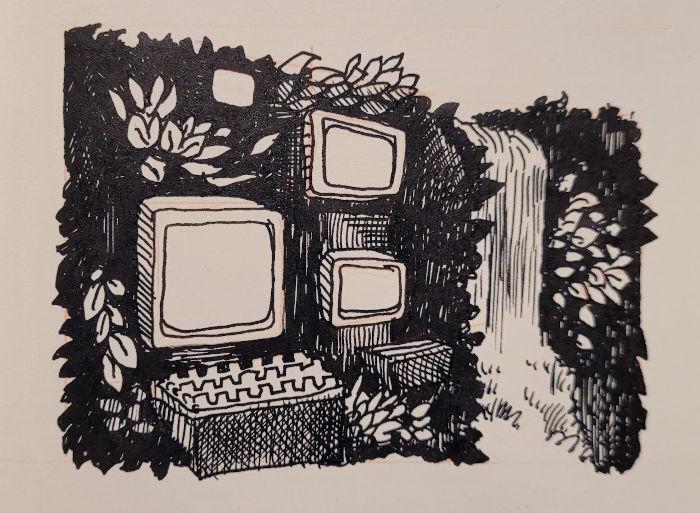
(Sketchbook drawing by the author, fountain pen.)
And speaking of my happy little garden of used computers, that brings me to the final point:
Saving money, reducing impact, and again, enjoying what we have!
I think we are very fortunate that Moore’s Law gave up the ghost after we achieved a level of cheap and reliable computation that, in my humble (but firm) opinion, satisfies everything a home computer user might reasonably want to do.
I realize saying that is just begging for people to come at me with the legend, possibly fiction, (computerworld.com) of Bill Gates saying, "640K ought to be enough for anybody."
But while no one could deny that computers were extremely limited in the everyday tasks they could do in 1981, in part because of limited main memory, I am not convinced we’re similarly constrained now.
One of my daily drivers is a 8 year old Lenovo 11E ("Education Series") with a Celeron N3450 CPU and 8Gb RAM, which was "underpowered" when it was brand new, "more underpowered" when I bought it used 4 years ago, and "woefully underpowered" now. I pay more to take the family for a modest meal at a restaurant than I paid for this computer. And yet, it’s perfectly capable of any normal home computing tasks you might wish to perform. Is that not incredible?
Are there things I can’t do on this computer? Of course! It’s not great for: modern 3D rendering, contemporary scientific simulations (e.g. weather, nuclear), or playing triple-A first person shooter games made in the last decade. Sometimes you actually need more power.
But what I can do on this old thing is edit documents, develop software, perform enormous mathematical calculations, process billions of records, and generally perform any action you’d expect to be able to do on a room-filling nation-scale supercomputer laboratory 30 years ago. Again, I posit this is enough for most home computing needs!
In a loose way:
Cray then == Celeron now
We live in an era of unbelievable computing opulence.
Doing productive things on on my computers is lightning fast. I’ve made computing sacrifices, but speed is not one of them. The amount of time I spend waiting for the computer is measured in milliseconds. The rest of the time, the computer is waiting for me.
That’s what I’m talking about when I say we’ve already reached cheap, reliable computing hardware for home use. You just have to make the right software choices.
Strong opinion warning: Unless you’re a very serious gamer, visual artist, musician, or other specialty where you need extremely powerful real-time processing, the era of frequently replacing your computer hardware to improve its capability is practically over for the time being. Am I scolding? Fine, I’m scolding.
And if you get into retrocomputing, here’s another bonus for truly old and "obsolete" computers: they suck at rendering social media websites.
Going offline. Now that’s ascetic computing. Disconnecting for a little while. Going inward.
About the drawings and such
In this cursed year 2026, I’m adding more drawings to my posts. And below every single one, I’m writing a little bit about the drawing so that you know I drew it myself.
Sometimes I have an idea for a web page and I dash something off same-day, but often I’m drafting, thinking, and incubating for a while. I think of things when I’m away from the computer (often at very inconvenient times) and I write them in my pocket notebook. And I doodle.
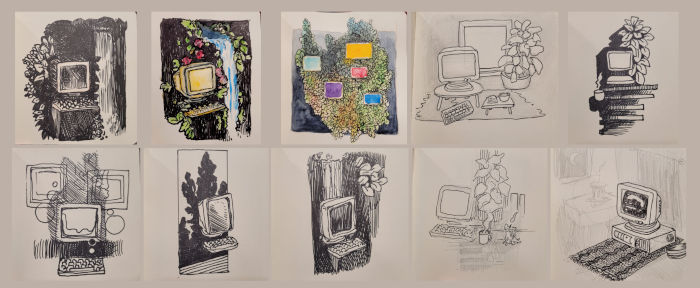
(Sketchbook pages: The other drawings I did while I was mulling over this page. Two are in watercolor, but I thought black and white and grayscale ultimately worked better. These are all from a very small sketchbook I’m nearly done filling.)
The doodles were always just for me, but I’ve realized they add a little more "flavor" to the writing. So why not? This page took a while, so I had plenty of opportunity to refine my doodles a bit.
I guess I just want you to know I wrote this, I drew this. And most importantly, you are reading actual thoughts from an actual person.
Anyway, that’s where the drawings are coming from.
UPDATE 2026-09-02: This also dovetails nicely with my book review for Digital Minimalism: Choosing a Focused Life… and my Offline card.